Wednesday, February 26, 2014

Big Cars and Big Cigars (Cuba, Part 1)


I flew into Havana, Cuba and my first thought was that it was the most disorganised airport I had even seen. I later realised that there was some kind of slow, lazy order to it all, but efficiency and professionalism just don’t exist. I have since decided that the same can be said about the Cuba itself.

Havana is the capital and looks as though stiff breeze could flatten it. The buildings are crumbling where they stand. Having recently been to Spain, Havana’s  Spanish colonial architecture looks particularly out of place in this tropical and heavily polluted environment. The people crammed in this city have a culture that is vibrant to say the least; their government, their history, their day to day – even the cars they get around in, is quite different to anything I’ve encountered.

The first thing I noticed, apart from the crumbling buildings, was the 1950’s American cars. I knew I’d see a few here, but I didn’t realise two thirds of the cars on the road would be something out of ‘Grease.’ Some of polished and well preserved, some bounce around the road looking as though they might fall apart to reveal nothing more than a man in a seat and the big engine. Soviet lada’s are also in abundance. And this tells a story:

 
Cuba was once a USA satellite state – hence the cars…sick of the blatant corruption of the officials and growing social inequality, the revolution was began by Fidel Castro, who fought with Che Guevara… both famous revolutionaries who can be seen on T-shirts all over the world (Fidel is the guy who never takes off his military uniform, Che is the guy with the beard and the star on his hat). They won, decided to scrap capitalism for socialism… right in the middle of the cold war… so here comes Russia to help Cuba further free itself from USA – hence the other cars… socialism becomes full blown communism, and it sticks.

 
This has led to 2014, where Cuba is famous for its education and healthcare systems (1 in 18 people is a doctor), and where the monthly salary paid by the government is $19 US. Everyone who speaks English here complains it’s not enough, and I’m told that when Fidel Castro dies it is inevitable that capitalism will be part of Cuba’s future. ‘It’s obligatory,’ my friend Ransel told me.

The Cubans don’t like their close neighbours, the USA. In the museum of the Revolution in Havana there are big paintings of several USA presidents being labelled ‘cretin.’ One is George Bush (Jnr) wearing a nazi uniform. The hate seems to be mutual. USA have blocked all trade and assistance, and it’s technically illegal for USA citizens to travel to Cuba. If a Cuban gets an offer to play baseball in the USA he must defect from Cuba and never return.

In Havana I rented a room from Ransel and his grandmother. He took me around town, showed me the best street food (street pizza and bowls of pasta are popular here, and go for less than 50cents each), showed me the extensive waterfront where Cubans hang out, took me to a canon firing ceremony and a few times to his favourite bar for Mojitos -  a Havana invention. One night we were joined by Ransels friend, a guitarist who sang songs I couldn’t understand and talked about his sister being too scared to fill her place on an illegal migrant boat headed for the USA that was leaving later that night.

He was a great host, and the casa (house) was in a lively neighbourhood. I sat out on the patio of an evening and watched the big cars rumble past, the kids playing baseball and soccer in the street, and the men whistling and calling out at the curvy senoritas. I have no idea why anyone would want to inoculate themselves from this (and pay way more) by staying in a western hotel.

Vinales was my next stop, and it proved to be a nice contrast to the capital. It was a small town built off agriculture, and nice to dwell for four nights taking it slow. I wandered around the countryside, watched school kids playing baseball, and took photos of the cosy little houses in the town and out in the fields. Here, every house has a rooster, there is always a goat and a pig and a skinny dog in sight, buffalos work the paddocks, and people get around in horse drawn carts. But there are the big 1950’s cars out here as well, which seem to be as comfortable on the rural dirt backroads as on the broken tarmac of the city.

On the bus to Vinales a crooked toothed hooker sat next to me and her pimp brother across the aisle. For the duration of the three hour ride they tried to convince me to stay at their place, have all the food I could eat, and have the girl whenever I wanted, all for the price of 25 bucks per day. I continued to tell her no, or that I couldn’t understand what she was saying (though I got the idea), refused to put my arm around her when she grabbed it to drape over herself, and even put my earphones it to try and block her out, only for her to take one and put in her ear. So there I sat, sharing earphones and listening to The Killers with the persistent whore. I’ve been propositioned by hookers with bad dentistry the world over now, and the idea of it remains as appealing as putting my dick in a blender.

In Vinales I rented a room of an afro-cuban family and they made me breakfast and dinner each night. It was a great experience and the food blew my mind, both the quality and quantity of it. I didn’t finish a single meal I had there. The final night I was given a plate of homemade chips, a plate of salad, a big bowl of tomato and bean soup, bread, a side dish of some vegetable I didn’t know (somewhere between potato and banana), a plate of buttery rice, a whole lobster cooked in a tomato and onion broth, and a big plate of fruit (including my new favourite, Wayawa). It was a ridiculous idea that anyone could eat this on their own yet there I sat each night with mounds of food in front of me.

Maybe I would have had better success if I wasn’t still feeling the effects of the food poisoning I got in Havana. Having gone through this too many times already, I went to the local pharmacy with my guide book, pointed at my stomach and said the Spanish word for antibiotic (which happens to be antibiotica). I didn’t realise how skinny I was until I got back into hot climes and started wearing shorts and t-shirts – could see my ribs no problem. The last thing I needed was to lose even more weight.

The landscape itself was amazing. I’ve seen these limestone karst landscapes in a few different parts of the world now, but what made Vinales especially cool was the cropping taking place in the fertile red soil all around the jutting limestone mountains. There was maize, pineapples and rice, but what the area is known for is its extensive tabacco plantations. This is where Cuba’s, and the worlds, best cigars are made. The lady’s son from the place I was staying at took me for a hike around the area, up into the karst caves, around tabboco paddocks, and stopping in at farmers houses along the way. Here I saw a man rolling the brown wilted and fermented leaves into a binder and then again into the final skin. Then he lit it up and started smoking it. I was told that these cigars aren’t bad for you. He said because Cubans smoke them only when they are happy, and not when they are stressed like how people in other countries smoke cigarettes, they are not bad for you. Sound rationale?

Back to Havana for a night then on to Santa Clara, a town where I stayed for three days and probably only needed three hours. The house where I rented was directly across from a cigar making factory with rows and rows of workers sitting in a big shed working under lamplight. I would sit and eat my breakfast and look directly across the small street at a worker rolling cigars. Here I also saw the Che memorial, a big Sunday market and I watched a couple of games of baseball, the national sport.


Next was an overnight bus down to Santiago de Cuba, where I was meeting a friend to further explore Cuba.

Wednesday, January 29, 2014

The Republic of Meat and Mead (Prague, Czech Republic)


Prague is a fairy-tale looking city that is all about eating fatty meat and drinking beer. I had to have put some weight back on here.

From Warsaw I got a 10hr bus to Prague, passing some great snow covered scenery and several idyllic, small villiages with mediaeval looking townscapes and steep, pointy rooftops, necessary to prevent a ceiling collapse when it snows this much.

I had five nights in Prague to get to know it. This picturesque city is the capital of Czech republic, former capital of Czechslovakia, former capital of Bohemia. The reason it is so nice is that it didn’t have the shit bombed out of it in the wars. A nice river runs through the middle of the city, and on a rise on the left bank sits the biggest mediaeval castle in Europe. There’s also nice town squares, bridges and unique architecture.

I got especially luckily because it snowed  a couple of times during my stay and turned the whole city into something out of Christmas fantasy.
The sad side of all this glory is that it is very touristy. The old town is lined with shop after shop of tacky souvenirs, with dumbass tourists who have just a day here spending all their time looking at junk instead of exploring the cool parts of the city. There is a Hooters, and a TGI Fridays, and if you want something even more authentic be sure to visit the restaurant off the main square that is named ‘Typical Czech Restaurant.’ 


Did someone say beer?

Prague is, according to Anthony Bourdain, the world capital of beer. The Pilsner Urquell is the hottest beer in town, and it literally translates to ‘original pilsner.’ It has been brewed and drunk in these parts since 1842. It’s a fact that nine out of ten beers produced and consumed in the world are derived from this original Pilsen beer.

Other beers that I took the time to familiarise myself with were the original Budweiser, one called Gambrinus (my personal favourite), the non-alcoholic beer, and even a cannabis beer (no, it doesn’t get you high). I know it sounds like a cliché, like when I said the Russian vodka was the best I’d ever had (it was!), but these beers were just so good. I’ve had beers all over the world now, from Mongolia to Malta, but the pilsners of Prague are the only ones I consciously savoured.

Prague also has a big absinth heritage and following, with shops all over town offering the spirit that is so strong it’s said that if you drink enough you’ll hallucinate and see a green fairy. Drinking beers alone in laid back pubs was where I drew the line - I wasn’t about to start doing shots of absinth by myself.

So how would you accompany such fine beer? That would be with food, or should I say, meat.

The food highlight for me was the ‘pig knee.’ Think endless moist meat falling off the bone. Oh, and lots of thick blubbery fat. Some people leave this part to the side. Not me. Put some mustard and horse radish with it all, half a cherry tomato and a couple of chillis and you have a feast fit for a mediaeval king. The first night I finished it and said to myself it was good but I didn’t need to put myself through that again; it was a challenge – took me 45 minutes and lots of sweating to finish.  Three nights later I went back and did it all over again.

Hotdogs are also something of an institution here. And I’m not talking frankfurts. I’m talking big, fat meaty sausage, several varieties of which you have on a bun with sourcrout, mustard and curry ketchup. With these ones, it’s not the sauce that runs down your fingers, it’s the bubbling fat from when you puncture the tough skin of the sausage. Oh yeah! There are street vendors selling them everywhere, and it’s cool to see the sausages hanging up. It’s Prague street food.

I also liked the chicken with cheese sauce and classic goulash with bread dumplings. Notice the absence of vegetables?

 
Prague was a nice way to say goodbye to Europe. Who knows when ill be back, ten, maybe twenty years? I left Prague and got on a plane to fly over the Atlantic, to start the next stage of my trip.


Saturday, January 25, 2014

Back to the Edgy Eastern Bloc (Poland)


Rin and I said yet another sad goodbye and parted ways in Paris. She flew home to move to New Zealand, and I flew to Poland.
Poland was a necessary chaser for the likes of Spain and France. And I’m glad I got a chance to get back into the eastern bloc once again on this trip. 

I like depressing countries in the same way I like depressing music and books. In Poland I faced gloomy weather, gloomy people, and their extraordinarily gloomy past. Melancholy by the truck load. This was the country that was spitroasted by the Nazi’s and the Soviets – and that sort of thing will leave you feeling bitter and sore.


Krakow, the mediaeval capital, was my first stop. I had eight days here to get to know the place and do some planning for the coming months. I arrived just in time for the final nights of their Christmas festival, and the first night I wandered the town square and ate spinach, meat, potato, and cheese dumplings, and other local dishes. Above me was the big cathedral with its sharp, pointed spires and the moon looming behind it.

 It didn’t take too long to notice the general sour demeanour of the locals. It reminded me of Russia actually.

On the final night of the Christmas festival there was a rock concert on the main square and I drank beetroot soup while watching a death metal band perform. The whole thing was in polish, but I was surprised when the lead singer started doing the hail Hitler gesture mid song. This, I later found out, is highly illegal, so I guess it must have been anti-nazi lyrics that I couldn’t understand. The shaved head threw me.

Maybe the reason people are so grumpy here is because an hour away is the location of the most notable mass murder atrocity of human history. Or maybe they haven’t forgotten the soviet reign that immediately followed. Or it could be the intense cold weather. Or all three?

I went out to Auschwitz, the biggest and baddest of all the Nazi run concentration camps, referred to as ‘death factories,’ by the Polish. When Hitler went on his mad rampage, the Jewish population of this region were rounded up and sent here and the only way out was through the chimney. 1.1 million people died in this single concentration camp, 90% of whom were Jews. Families arrived together, then the men and strong women were taken one way to work for a couple of months (at most) while the elderly, most women, and the children were led directly to part of the camp that acted as a waiting room for the gas chambers. Some were walked straight from the train to the gas chambers, being told to get undressed and go and wait under the showers that weren’t connected with any plumbing.

We were taken into the gas chambers, and saw the big ovens where the bodies were burned after they had died. We also saw a room with 2 tonnes of hair cut off girls and women before they were killed (Nazis intended to sell it). There were big piles of suitcases, glasses, and shoes. It was such an intense experience that some people on our tour of the facility started to cry.


What happened at Auschwitz is one of the most shocking things I’ve ever had to contemplate. But what affected me the most was not the sheer number of deaths, or the horrific way and which they died (the gas was slow and extremely painful). It was seeing the everyday things they had to deal with while still alive, like the squashed sleeping conditions on hard wooden shelves and the toilets (pictured) where they were all marched twice a day to go and were given 20 seconds each. If they were any longer they were yelled at ‘this isn’t a café’ and beaten.

There were a few brief and unsuccessful uprising by the Jewish prisoners who knew they would never get out alive, but generally they were so worn down and utterly dominated that they just followed orders and staggered down into the gas chambers knowing they were about to die.

Auschwitz was liberated by the soviet army who came in from Russia and sent the Nazis packing. Cause for celebration? Yeah, kind of. But just when Poland though it was out of trouble, so began the long and harsh soviet rule. Germany had had its turn, now it was the Russia who could have its way with lady Poland.  Sure, there was no mass murdering to extent of genocide, but life was far from pleasant.

Situated right next to Krakow is Nowa Huta, or ‘New City.’ It is though most distinctly communist place I think I’ve ever seen. It has rows and rows of identical grey apartment blocks for the industrial workers. I’ve seen these apartment blocks all across the former soviet union lands, from Mongolia to Bulgaria, and these were no less depressing. But the thing about Nowa Huta, is that the whole area was designed by the communists from scratch. Its just such an alien way for people to live. In a place like this it would be easy to assume the role as a non-thinking cog in the drear machine. It’s a sickly combination of depressing and boring, exactly what I’d imagine life under communist rule would be like. Its retro dystopic; a George Orwell nightmare.

Back in Krakow I met up with some Australian guys and we went out for a big beer and pork knuckle on the cheap.

Next was Katowice. I’m not sure why anyone would come here. I visited purely to give the bigger, historical towns of Krakow and Warsaw some contrast. I wanted basic Poland working class and I got it. The place had enough of a communist hangover feel that I was happily occupied for a couple of days, and I also had some great food ordered from menu’s I could read. Always fun.


Warsaw, the capital, was my final stop and I hit the jackpot. I rented a room in the apartment of a young local guy for three nights and it turned out he lived in one of those depressing communist buildings. Having looked at so many of these ‘human filing cabinet’ apartment blocks in bewilderment, I was finally able to live in one for a few days. In fact, the whole area of the town where I was staying was built in the 50’s and had that same strange vibe as Nowa Huta. By the end of my stay I got so excited when I came around a corner and saw a distinctly depressing building block that it made me feel a little weird. I don’t know why I like seeing this so much. They had become gloriously ugly to me, the drearier the better.

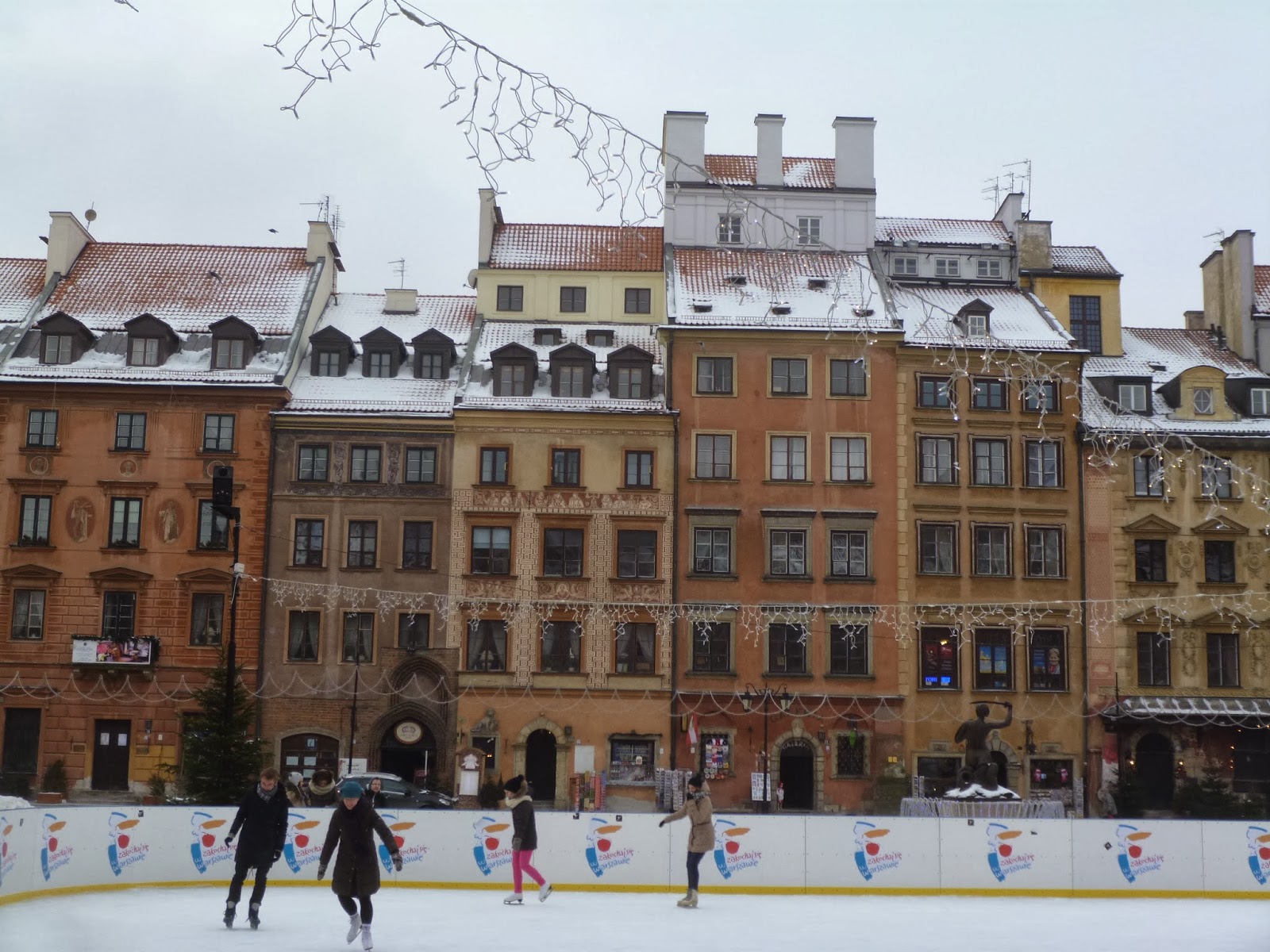
The centre of Warsaw was nice, and the snow dusting on the buildings made some areas look like miniature Christmas town set ups. It all looked quite old but was actually relatively new, seeing as 85% of the city was destroyed in WW2.
It got so cold here that I nearly passed out. It was -14 maximum and despite putting layer after layer of clothes on it quickly became obvious that I did not have the right gear for the conditions. At first my hands and feet stung like they were being scalded, then they just went totally numb and I couldn’t feel or move them. I wore several pairs of socks on my hands (on top of my gloves) the next day.


A highlight of Warsaw was the milk bars, which sold cheap, homely Polish food for crazily cheap prices. Apparently, these milk bars are a left over from the communist days (milk for good communist comrades, not alcohol) and are basically the same now as they were then. Typical highlights included pork schnitzel, fried cabbage, potato soup and buckwheat cooked in lard.

The first couple of times I went in the one near me I had to point up randomly at the menu on the wall I could not read, and having to turn her neck to look what I was pointing at was obviously well above the cashiers pay bracket because she was pissed off about it. I decided to take a photo of the menu, and on my final visit I handed her a piece of paper with everything I wanted written down – copied from the menu photo.

And then it happened, after all my time in Poland I finally saw it! In the country of dreary weather and people and past, in the most devastated European city of WW2, in a crumby soviet milk bar filled with people who remember harsh communist regime, the stone faced cashier looked up at me and smiled.

Wednesday, January 22, 2014

Classic or Cliché? (France, Part 2)


Paris, the biggest tourist destination in the whole world. It is, with New York, the most celebrated city on earth.   I couldn’t tell if I was going to love or hate it, but I knew I was going to feel something when I got there. Of all the things we did in Paris, I’ve decided what is tourist trappy cliché, and what is undeniably classic:

The EIFFEL TOWER

This is the most famous building in the world, and seeing it is person is pretty amazing - partly because of the size and style of the structure, but also because of how often it appears in pop culture and then suddenly it’s right there in front of you for real.
Sure, most Parisians haven’t been up it since they were kids, but it is without a doubt the biggest symbol of Paris, and something that sits, has always and will forever sit, in the background of daily life here.  

Eiffel Tower…CLASSIC


THE LOUVRE
We were there when it opened and made a B line for the Mona Lisa, hearing about how crowded it gets. It was just us and a few other people, so we certainly got a good look – as good as you can five metres away and from behind two panes of what I assume was bullet proof glass. It wasn’t long before the few people swelled into a big crowd and I was glad that we had soaked it in in the few moments we had with it.

Yeah, it was okay. But completely overhyped. Certainly wasn’t my favourite piece.
We spent 3.5 hours in the Louvre and it was the highlight of Paris for me. The still life paintings capturing European life of old were particularly cool, and I could of gone back day after day had I the time and money. The art itself, as well as the endless rooms and beauty of the museum, totally blew my mind.

Mona Lisa…CLICHÉ, but the Louvre in whole…CLASSIC

MOULIN ROUGE
Everybody has heard of the Moulin Rouge. It used to be the hottest place in the city, a burlesque show that drew the rich and the famous from all over Europe. It used to be edgy and exciting, and somewhat stylish. Now it seems to be nothing more than a tacky caricature of its former self, geared entirely towards tourists. Boo.

It’s the least seedy part of the seedy red light district filled with sex shops and peep shows. There’s even a Starbucks right across from it for god’s sake.
There are other nearby venues doing burlesque shows, all claiming to be the more authentic version, but I doubt you’d find single local in any of them.

Moulin Rouge…CLICHÉ
 

LOVERS BRIDGE
This is a bridge whose wire fencing has been completely filled up with padlocks, most of which have the names of two lovers. The thing to do is go there with a lover, lock the padlock on together and throw the key in the river Siene, thus locking your love together forever.

It’s a shame that these are regularly cut off or trimmed by the local council because the bridge wasn’t designed to take that sort of extra weight. Kinda makes the whole thing seem superficial and pointless. (No self-respecting Parisian would be caught dead putting a padlock on). But sometimes a cliché like this can be fun, so me and Rin put a padlock on, threw the key in the river, and left instructions for Mum and Dad to come find when they rock up in Paris in a few months.
Lovers Bridge…CLICHÉ (but in a good way)


THE ARC DE TROMPHE
The Arc de Trompe was built by Napoleon to welcome his soldiers back into the city, and it’s one of the city icons. The fact that its covered with people taking photo’s isn’t a turn on, but it is somewhat impressive as a structure, and instead of being isolated for preservation it is at the centre of one of the cities busiest round about at the top of a long avenue.

Arc de Tromphe…CLASSIC


FRENCH CUISINE
We ate well is France, but especially Paris. It is considered one of the top cuisines in the world. Yes, it was expensive, but thats just Paris. The food was quality and eating in the little bistros was nice. We tried duck in many different ways (we ordered it in every restaurant we went to in France), onion soup, fois gras, casserole, and good old steak frites. We even bought some nice cheese, only to bin it thinking it was off. Then we ordered the exact same thing after our meal one night at a bistro, and it stunk just as bad. Turns out the cheese we threw out wasn’t off, it was just living up to the French reputation for stinky cheese.

In addition to the fancy stuff, we ate plenty of banquets and croissants, macaroons and éclairs.
French Cuisine…CLASSIC

 
SACRED HEART
This cathedral sits on a hill overlooking the city, and houses some great mosaic works. It’s the first thing we did when arriving into town, and just as we made it up the hill the sun came out and shone on it with a  rainbow in the background, as if the old dude in the sky with the bushy beard was welcoming us.

Sacred Heart…CLASSIC

 
THE NOTRE DAM
I gotta say, this one was a disappointment. I guess I was expecting something epic, something that lived up to the impossible reputation. But truthfully, I’ve seen more impressive cathedrals in most European countries I’ve been two (even other towns in France). Instead I have put a photo of another part of the city.

At least it was free.
Notre Dame…CLICHÉ


PARIS

Paris overall was a hoot. I never intended or expected to come here on my travels. But now that I have I understand what all the fuss is about, I get it. This city has so much soul, so much distinct personality, that not even hordes of tourists have been able to corrode its character. Paris is a classic.